

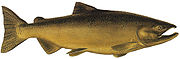
 Salmon is the common name for several species of fish of the family Salmonidae. Several other fish in the family are called trout; the difference is often said to be that salmon migrate and trout are resident, a distinction that holds true for the Salmo genus. Salmon live in both the Atlantic (one migratory species Salmo salar) and Pacific Oceans, as well as the Great Lakes (approximately a dozen species of the genus Oncorhynchus).
Typically, salmon are anadromous: they are born in fresh water, migrate to the ocean, then return to fresh water to reproduce. However, there are rare species that can only survive in fresh water. Folklore has it that the fish return to the exact spot where they were born to spawn; tracking studies have shown this to be true but the nature of how this memory works has long been debated.
The salmon spend about one to five years (depending on the species) in the open ocean where they become sexually mature. The adult salmon returns primarily to its natal stream to spawn. Prior to spawning, depending on the species, salmon undergo changes. They may grow a hump, develop canine teeth, develop a kype (a pronounced curvature of the jaws in male salmon). All will change from the silvery blue of a fresh run fish from the sea to a darker color. Salmon can make amazing journeys, sometimes moving hundreds of miles upstream against strong currents and rapids to reproduce. Chinook and sockeye salmon from central Idaho, for example, travel over 900 miles (1,400 km) and climb nearly 7,000 feet (2,100 m) from the Pacific ocean as they return to spawn. Condition tends to deteriorate the longer the fish remain in fresh water, and they then deteriorate further after they spawn, when they are known as kelt
(from Wikipedia)